Loading…

An independent educational project in Gyumri that makes current theoretical and practical knowledge in traumatology and orthopedics accessible to practising physicians — through concentrated lecture teaching and a large volume of hands-on work.
Gyumri Orthopedic School is an educational project based in Gyumri, Armenia, dedicated to traumatology and orthopedics. It exists to close a practical gap: specialised surgical knowledge advances quickly, while structured opportunities to learn and rehearse it are not always within reach of the physicians who need them. The school addresses this by bringing recognised specialists to Gyumri and teaching in a format that pairs theory with time at the instrument table.
The school works as a recurring cycle of courses rather than a one-off event. Since its first courses in 2019 it has convened surgeons in Gyumri several times a year, each course built around one clearly defined clinical area — joint replacement, shoulder trauma, hand surgery, foot and ankle surgery, fracture management, bone and joint infection, orthopedic oncology or soft tissue reconstruction. Selected larger events have also been held in Yerevan.
Teaching is delivered by practising physicians who are leading specialists in their own fields, invited from Armenia, Russia, the United States and other countries — among them heads of orthopedic departments and university faculty from Yerevan, Moscow, Yaroslavl, St Petersburg and Tbilisi. The 2022 cycle of courses was announced as taking place under the aegis of the Eternal Nation foundation, a direction ASCEL also presents on this website.
The school states its own purpose plainly: to increase the accessibility of the most current theoretical and practical knowledge in the field of traumatology and orthopedics. Everything about the way courses are designed follows from that single aim — the choice of faculty, the balance between lecture and practice, and the decision to hold the courses in Gyumri rather than only in a capital city.
The same aim sets the scale of each course: enrolment is capped so that every participant gets real time at the model, and what has been learned is checked by testing before certificates are issued.
Make current knowledge in traumatology and orthopedics genuinely accessible to practising physicians.
Pair concentrated lecture teaching with a large volume of supervised hands-on practice.
Bring leading specialists from Armenia and abroad to teach in Gyumri.
Confirm that the material has actually been absorbed, through testing during each course.
Every course follows the same structure: a lecture-and-practical programme running over one to three days. The lecture component is dense, moving through classification, decision-making, preoperative planning and surgical technique, with each talk given by the faculty member who works most closely with that problem. The practical component then occupies a substantial share of the timetable.
Hands-on work is carried out on plastic bones and anatomical models using instrumentation from leading manufacturers, so that participants can rehearse surgical approaches, osteotomies, implant removal, plate and nail fixation, cementing technique and reconstruction on a model before applying them in the operating room. Instructors demonstrate a technique first; participants then repeat it in small groups. Testing is conducted during the courses to assess how well the material has been absorbed, and certificates are presented at the closing session.
Concentrated theory on classification, indications, decision-making algorithms, preoperative planning and surgical technique.
Work in small groups on plastic bones and anatomical models with instrumentation from leading manufacturers.
Instructors perform each technique on the model first, so participants see the full sequence before repeating it themselves.
Case discussions and moderated panels in which the whole faculty and the participants work through real decisions together.
The courses are addressed to the clinical team as a whole rather than to a single specialty. Programmes published by the school show surgeons, operating room nurses, radiologists and clinicians engaged in research all taught in dedicated formats, sometimes in parallel sessions on the same dates.
These formats often run in parallel — the School for Operating Room Nurses alongside the arthroplasty course — so a whole department can attend the same event and return to work with a shared approach.
The core audience of every lecture-and-practical course, from primary and revision arthroplasty to fracture management and reconstruction.
A recurring School for Operating Room Nurses runs alongside the arthroplasty courses, covering patient positioning, instrument sets, sterilisation and the nurse's role in revision surgery.
Invited alongside surgeons for shared sessions — for example the 2022 event on orthopedic radiology of the lower extremities.
A dedicated 2022 course on the essential principles of clinical research covered problem formulation, study design, ethics review, statistics and publication.
Hand surgeons, foot and ankle surgeons, and specialists in orthopedic oncology and soft tissue reconstruction, each addressed by their own course.
The published archive of past courses maps out the clinical territory the school has covered since 2019. Each area below corresponds to one or more courses, seminars or conferences that have actually been held.
A selection from the school's published record of courses and announcements, most recent first.
The record shows both the cadence — several courses a year — and a widening range, from the first knee replacement course in 2019 to orthopedic oncology and soft tissue reconstruction.
A two-day course on revision hip arthroplasty: preoperative decision-making, removal of cemented and cementless components, classification of acetabular and femoral defects, periprosthetic infection and periprosthetic fractures, with a cement spacer master class. A School for Operating Room Nurses ran alongside it on 23 May.
Injuries of the shoulder region: surgical anatomy and anterior, posterior and transdeltoid approaches, proximal humerus and scapular fractures, clavicle dislocations, shoulder arthroplasty and humeral shaft fixation — with group practical exercises on both days. Enrolment closed once the course was full.
Local flaps of the lower extremity, taught by a microsurgical faculty: vascular anatomy of the thigh, leg and foot, then vastus lateralis, ALT, gracilis, gastrocnemius, soleus, sural, perforator and plantar flaps, each demonstrated by the instructors. Fifty places, closing with the presentation of certificates.
Results so far · 18
Official website
Course programmes, faculty listings, venues, registration terms and current announcements are published and maintained by Gyumri Orthopedic School on its own website.
This profile is an ASCEL summary based on publicly available information from the official Gyumri Orthopedic School website. It is not a copy of that site, and it does not replace it: course details, dates and registration terms are maintained by the school itself.
Testing during the course checks how well the material was absorbed; certificates are presented at the closing session.
Places are capped so that practical work stays workable — 50 participants on the 2025 reconstruction course, 70 at the orthopedic oncology seminar.
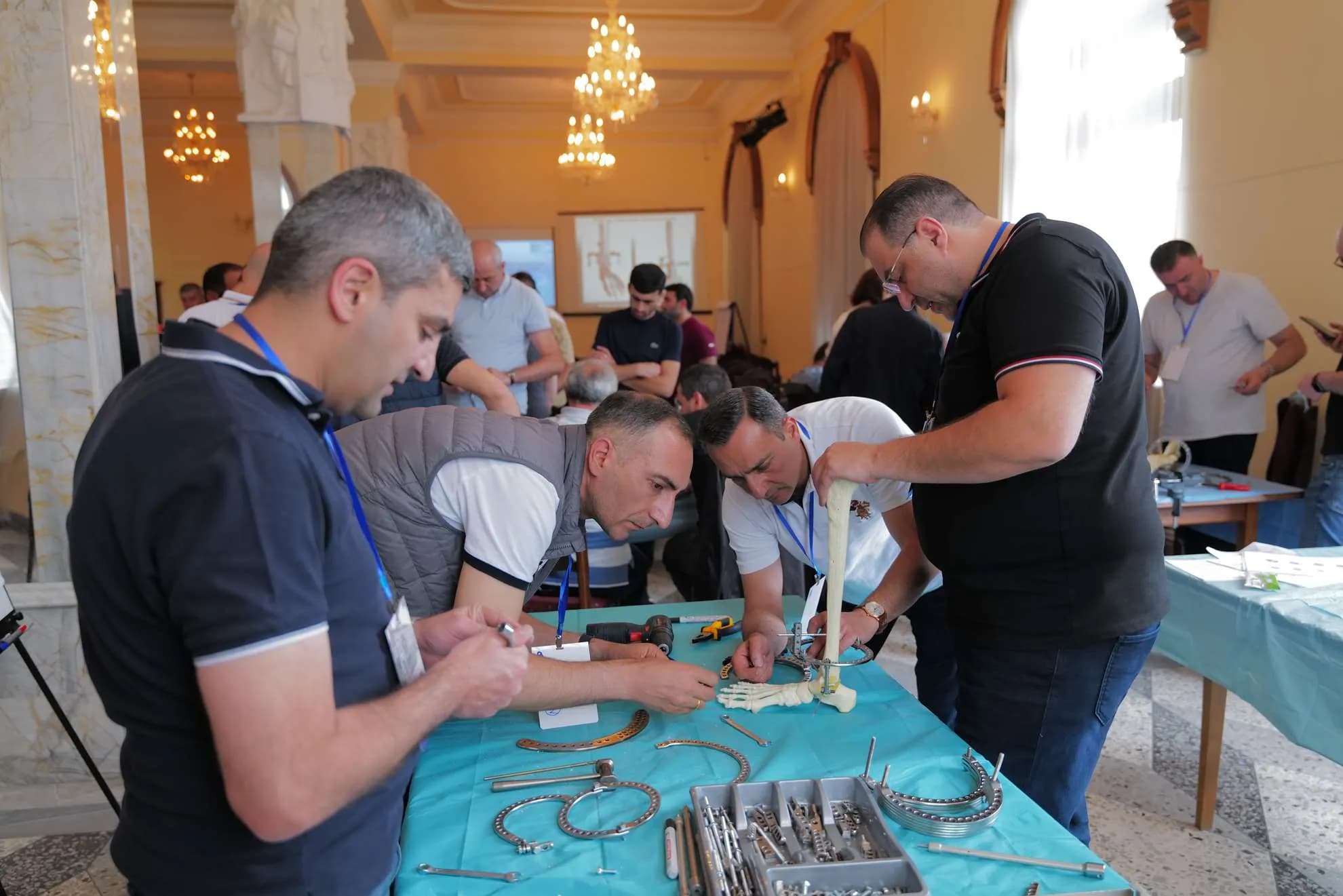
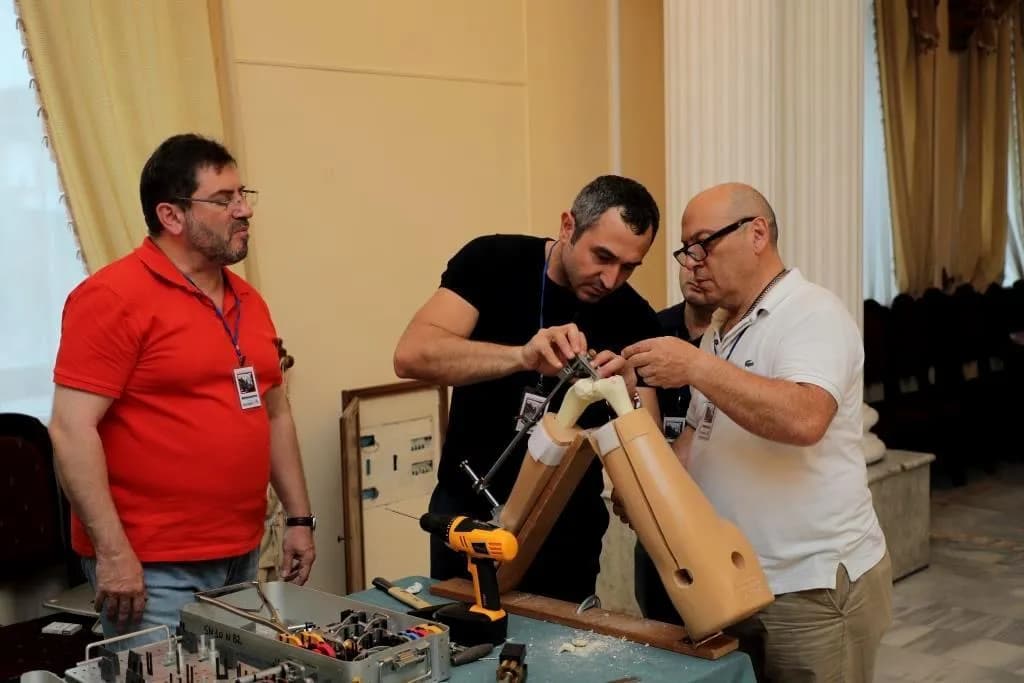
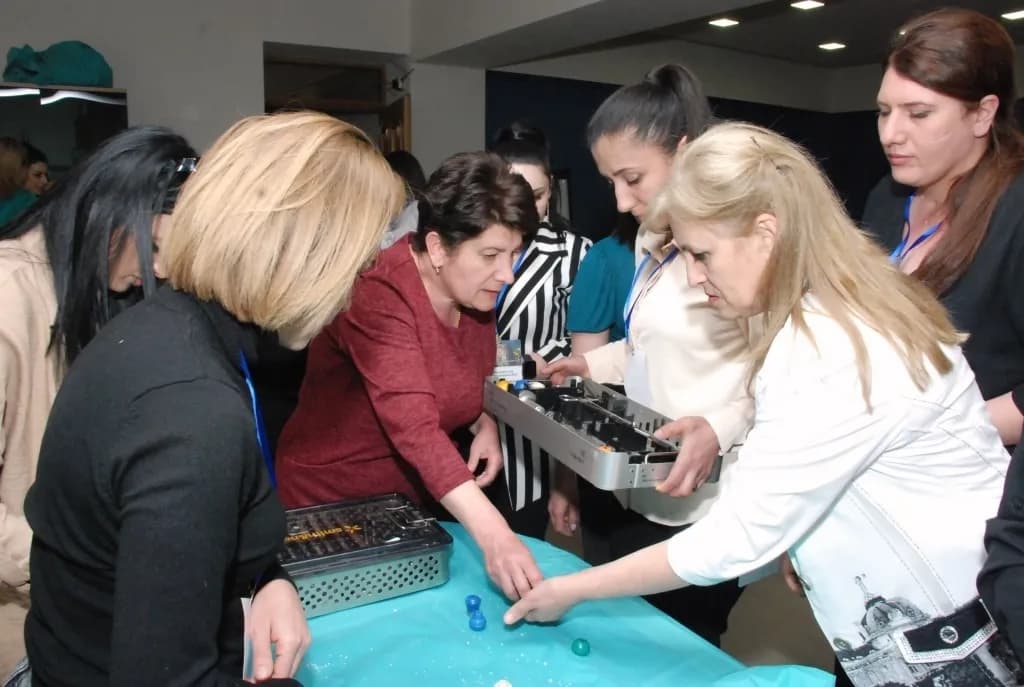
The list grows from year to year, and an area returns when demand justifies a second course — hand surgery, for example, was taught in 2021 and again in 2022.
A one-day seminar covering staging of musculoskeletal tumours and the extent of surgical intervention, biopsy methods, benign lesions, giant cell tumour, osteosarcoma, chondrosarcoma and the Ewing sarcoma family, closing with a joint clinical case session. Faculty came from Yerevan and Tbilisi; seventy places were offered.
An advanced course on the principles of hip replacement, with a parallel School for Operating Room Nurses on 24 May devoted to patient handling and instrumentation during hip arthroplasty.
A course for orthopedic surgeons on the diagnosis, arthroscopy, surgery and rehabilitation of the shoulder joint — one of the school's events held in Yerevan rather than Gyumri.
A three-day lecture-and-practical programme on polytrauma and fractures of the pelvic bones, held in Gyumri.
Announced at the end of December 2021, the 2022 programme comprised an advanced hip replacement course, a bone and joint infection seminar, an external fixation course led by recognised authorities in the field, a hand surgery course and a basic knee replacement course. Two further events followed the same year: a course on the essential principles of clinical research on 11 June and a session on orthopedic radiology of the lower extremities on 3 December.
The school opened with a basic knee replacement course, accompanied on 29 June by the first School for Operating Room Nurses — the pairing of surgical and nursing education that has been repeated at almost every arthroplasty course since.